
 |
 |
News Features
Locals Spend Days Dealing With Deep Freeze 2026
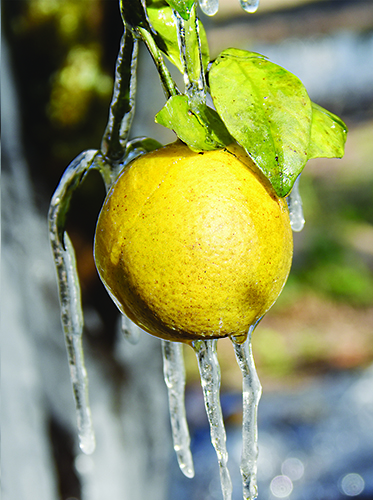
The coldest winter in at least a decade brought new seasonal lows this week, as low-lying and outlying local areas reported temperatures as low as 14 degrees early Monday morning. The hard freeze created a myriad of problems in the area, from utility disruptions to broken water lines. Area agricultural interests held their breath through midweek in hopes that their crops wouldn’t suffer catastrophic loss.
Temperatures dipped into the 20’s again early Tuesday, ahead of an expected warming later in the week.
“We’ll have an idea by the weekend,” said Michael Graham of Umatilla’s Graham Farms. Graham oversees the area’s largest peach operation, with the weekend freeze likely killing the bloom on trees.
“All the blooms you see on a tree are dead,” he said, while surveying the ice-covered situation on Monday, which saw his orchards turned into a winter wonderland of ice. While later blooms could still salvage this season, Graham said a big worry was the potential for splitting wood in trees as the weight of ice grows as water flows to protect buds on trees. Those buds, which are yet to fully blossom, could still be saved and with them this coming season’s harvest.
Graham estimates up to half of his trees blooms had already popped before the freeze, though he said protecting the trees and early buds from here on out could result in a proper crop.
“Three percent is all you really want,” Graham said of the practice of thinning small fruit from trees early in the growing process. That allows the tree to focus on making larger fruit. This year, everything works out, the annual thinning process will simply be quicker, with the overall marketable crop unaffected by the cold.
“It could have been worse,” Graham said of the overall situation.
Mark Giles agrees. Giles oversees a large swath of citrus northeast of Umatilla near the North Lake Regional Park. On Monday, he had a crew on site picking late season Valencia varieties in an effort to get them to market.
“We did cut ice,” Giles said, noting frozen fruit in some areas. That fruit was being harvested and quickly shipped for hoped-for sale as juice.
In other areas, Giles said remaining tangelo varieties fared well. In addition Giles said he was seeing no split wood, a sign that trees were damaged from the freeze.
In years past, such cold temperatures as seen early Monday would likely bring devastation to the citrus industry. However, the extended cold snaps experienced this year help to ‘harden off’ trees, with sap pulling back toward the tree’s central wood, preserving it from the cold.
“I think it played a big part,” Giles said of the weather that allowed the trees to be somewhat prepared for, and survive, harsh cold.
Giles said he also believes that the use of microjet sprinklers under tree canopies helped create enough ‘warmth’ to preserve the tree core. Giles credited the work of the late Umatilla grower Nick Faryna, a member of the Florida Citrus Hall of Fame, who pioneered the technology. Much of the grove area Giles is working today was put in place by Faryna.
“There are above-average systems there that Nick Faryna put in. We are able to put high volumes of water out.”
More broadly, the same concepts could be saving groves as far north as Madison County, near the Georgia state line. Graham oversees citrus there, and on Monday marveled how the trees that far north are handling the cold. Short of some leaf burn and minor wood splitting associated with the even-colder-than-here freeze, Graham said those trees appear poised to survive, even thrive. Due to the colder winters in that area that kill the deadly citrus psyllid, the trees are nearly completely free of citrus greening.
“It defies logic how well they are doing, but they seem fine,” Graham said.
From blueberries to strawberries, to watermelons, Florida growers are facing uncertain months ahead. But after the worst freezing nights in years passed over the area, it appears things could have gone much worse.
The Outpost Publishing Company
P.O. Box 1099, Umatilla, FL 32784
Phone: 352-669-2430 ~ Fax: 352-669-4644
contact@thenorthlakeoutpost.com