
 |
 |
News Features
It's Iris Month In Florida
By Ruth Cantillon
What’s your favorite flower? Asked point blank, I’m hard pressed to answer that question. My husband would tell you I’ve never met a flower I didn’t like (or a “weed,” either, but that’s a different story). It’s easier to answer if I arrange my favorites into months, or seasons.
In early March, I heard through one of my Facebook groups that the wild, Sky-Blue lupines were starting to bloom, so part of my birthday celebration was to make our annual drive over to the Lecanto area in search of these elusive beauties. They thrive only in poor, sandy soil and grow in scrubby pinelands, open oak woodlands, even coastal dunes. Lupines are usually found in clusters; because of their deep taproots, they are nearly impossible to transplant safely. They are also notoriously hard to grow from seed; I haven’t found any in native plant nurseries, so for now, we just enjoy them in the wild.
April is the month for irises in Florida. Although the big, bearded iris found in spring gardens up north won’t grow here, there are several types that will.
Prairie iris (iris savannarum) is a Florida native found in wet grasslands and wetland marshes, with pale blue to lavender flowers. This type would be challenging for most home gardeners: they aren’t grown commercially. Likewise, the native Giant Blue iris, also only found in wetlands. Bartram’s Ixia, extremely rare, is found up in northeast Florida and is protected. Carolina Iris and Copper Iris are other native northeastern Florida varieties that are uncommon here. Enjoy all of these in state parks and preserves.
The native Southern Blue Flag (iris virginica) is more promising for home landscapes, as are the native and hybrid varieties of Louisiana irises. These are blooming right now in ditches and natural wetland areas in along the Gulf and in north Central Florida. On a trip last week to Cedar Key and the Lower Suwannee River National Preserve, we saw huge swathes of blue flags in the ditches along the roads and trails we were traveling.
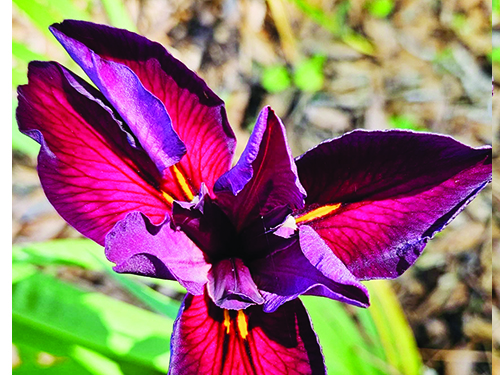
Early in my gardening efforts, I ordered some Louisiana irises online and planted them down near our lake. I underestimated their need for wet feet; at the time, we were in a lengthy dry spell and water levels were low. They did not thrive. The next year, I found a random cultivar of the Louisiana iris called “Red Velvet Elvis” at Home Depot and planted it in a moist, partly shaded place in my garden. It gave joy for several years but there’s no trace of it now. However, both Louisiana and blue flag irises can be grown successfully at home if placement is correct. If you have a backyard pond or rain garden, these irises should be planted right in the wet edges. I’ve seen people plant them in clay pots, keep them moist, then plop the whole pot in their garden pond when the leaves are tall enough to show above water. In consistently moist to wet conditions, your irises will come up year after year. Over time, the rhizomes (roots) will spread- if they get too thick, they can easily be dug up, divided and replanted.
Another iris that will grow well here is the drought tolerant African iris (Dietes iridioides). It’s most commonly seen in white, but is available in yellow and purple tinged varieties, too. These can take our Florida heat and can be planted in any full sun area of your yard.
I like “Walking Iris,” sometimes called “Apostle” iris (neomarica spp). They reproduce by forming new plantlets on the ends of long stalks, which then bow to the ground to root. I have them in blue; they can also be found in white or yellow at local nurseries. The flowers only last for a day, but each plant will continue to send up new buds regularly throughout the season. Mine typically bloom from April-May. They’ve done best for me in partial shade.
Keep in mind that these plants are tall. They’ll look best when placed towards the back of your flower beds, or use them as a focal point in your landscape. Irises are good for pollinators, too- bumble bees in particular enjoy wiggling their way down into the center of the flower; I occasionally see a swallowtail butterfly feeding on them as well.
Other “spring blues” that I love seeing this time of year are spiderworts (Tradescantia ohiensis), wisteria (the Chinese is considered invasive, but there is a native variety available), delphiniums and various blue or purple salvias. All of these add pops of deep color to sunny spots and attract bees and butterflies.
Do you have a favorite? Is there a flower you’ve been growing- or trying to grow- in your central Florida garden that you’d like to see featured here? Let me know- send a photo- and happy growing.
The Outpost Publishing Company
P.O. Box 1099, Umatilla, FL 32784
Phone: 352-669-2430 ~ Fax: 352-669-4644
contact@thenorthlakeoutpost.com