
 |
 |
News Features
Encourage And Observe Nature
By Adrian Newby
Encourage and Observe Nature
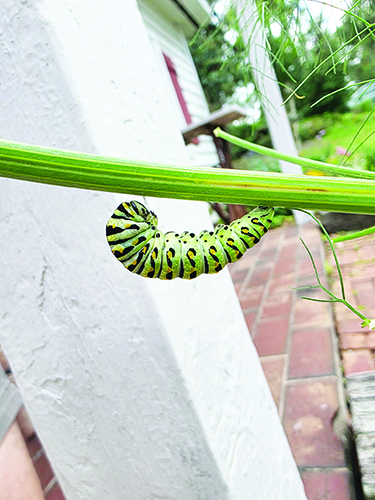
Just outside our front door, we have a one-pot herb garden. In that garden, we have a large Dill plant, but a few days back we noticed it had lost a lot of its leaves. Upon further inspection, we noticed that the reason for this loss of leaves was one, fat, Eastern Swallowtail caterpillar. Also known as a Black Swallowtail, they are one of the prettiest butterflies we have in our area.
The Eastern Swallowtail is a relatively deceptive name, as they have a massive range. They can be found all of the way from the northeast and north central U.S. and some parts of Canada, down to Mexico, and out to California. Unlike the Monarch, they do not partake in a mass migration, they will only ever go a few miles from the place of their birth. At the high end of their life expectancy, they can reach two months, but this is considered old age.
If you would like to be able to watch these beautiful butterflies go through their lifecycle, we would recommend planting both host plants and nectar plants that they like. Host plants are plants on which adult butterflies will lay their eggs on, but if you want to watch them in their adulthood, you will need plants for them to drink nectar from.
Swallowtail caterpillars love dill, parsley, carrot tops, and cowbane. You can look up other host plants for these stunning creatures, but if none of these sound appealing to you, you can look up other host plants, but be sure that you choose plants that the specific butterfly you are interested in will eat, because all caterpillars have different diets. As far as nectar plants go, any native wildflower will work; also milkweed, pentas, and zinnias are strong attractors.
It is always magical watching butterflies come and lay their eggs, then watching the caterpillars go through their life cycles. Once, we had the pleasure of letting freshly hatched butterflies crawl on us before flying away. It is always fun to watch, observe and help nature, and natural life cycles from a distance, and we can’t recommend planting butterfly plants enough.
Just for the record, if you want to have wildlife like this in your yard, you cannot use pesticides at all, and little to no herbicides, as that will kill native flowering plants.
The Outpost Publishing Company
P.O. Box 1099, Umatilla, FL 32784
Phone: 352-669-2430 ~ Fax: 352-669-4644
contact@thenorthlakeoutpost.com