
 |
 |
News Features
District Ranger Set For Retirement
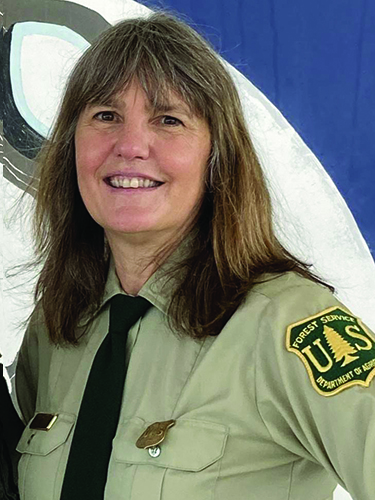
The Ocala National Forest will get new leadership in the near future, as district ranger Carrie Sekerak is set to retire. A 35-year employee of the U.S. Forest Service, Sekerak spent many years as a biologist on the forest before ascending to her current post, which oversees operations of the entire Ocala National Forest, the oldest national forest east of the Mississippi River.
August 31 will be her last day on the job.
The Ocala National Forest was established in 1908, and covers roughly 607 square miles. Historically staffed by two rangers working independently out of offices in Silver Springs (for the Lake George District which covered areas north of SR 40) and in the Umatilla area (for the Seminole District which covered areas south of SR 40), the forest in recent decades was consolidated under a single ranger, though both offices have remained open. Additionally, the forest is home to the Pinecastle Navy Bombing Range, a nearly one-of-a-kind situation that sees the Forest Service work with the U.S. Navy to oversee the operation of a large training facility in the heart of the forest.
“My heart is torn in leaving,” Sekerak wrote in an email distributed in recent weeks. “It’s hard to leave the U.S. Forest Service. I love it dearly and still believe in the vision of Teddy Roosevelt.”
Sekerak’s career with the Forest Service began in 1991 as a student co-op employee with the Apalachicola National Forest. Upon graduation from the University of Florida in 1994, she became a wildlife biologist with the Ocala National Forest, a position she held until 2017 when she became deputy ranger. In 2020, Sekerak ascended the post of district ranger. Today she oversees 55 employees and a volunteer corps that swells to around 60 in the winter months.
Along the way, Sekerak’s love of the outdoor world drove her to always work for the forest, and the people who enjoy it.
“These are resources of the people,” she said, remembering being a child and seeing environmental decay on the news. It was as a child she decided to dedicate her life to conservation. “I said ‘I can’t wait until I’m 18. I’m going to do something about this’”.
The Ocala National Forest’s popularity makes it ripe for damage from over use, and Sekerak says she has been pleased over the years to work with varying groups and interests in forwarding forest preservation with public use. In most cases, the work has been positive.
“We can’t be wide open, and it gets harder and harder. But we’re all in it together.”
Looking back, Sekerak sees plenty of victories.
“We restored populations of rare species and thousands of acres of habitats, watersheds, soils, and several damaged and altered areas,” she of her career accomplishments.
Building and rebuilding habitats are a highlight of working in the forest; the ongoing need to restore areas after human degradation was often a frustratingly large part of the position. From lake edges to improved recreation sites, Sekerak over the years would voice exasperation with abuse of the forest undertaken by a minority of users. In addition, in recent years she voiced opposition to plans that could one day see a paved recreation trail carved through the forest as part of the state’s trail system. At public gatherings about the potential of the trail in the forest, Sekerak has voiced fear over additional ‘fragmenting’ of the forest by a new road that would serve as the trail, negative impact on the forest’s native species, and potential abuse by users.
The Ocala National Forest experiences a high level of user ‘pressure’, with a large number of users attracted based on its many recreational offerings and proximity to large population areas. In an effort to reduce segmenting issues, the Forest Service nearly 20 years ago closed an estimated 600 miles of dirt paths and trails in the forest in an effort to protect forest habitat. That project, a mandate from higher up, was accomplished in partnership with recreational stakeholders, a ‘bipartisan’ program that had positive results.
What’s next for Sekerak? Not even she knows for sure.
“I’m going to have more life in my work/life balance,” she said Monday. “Time to reset myself, visit friends and family.” And plenty of more time in the woods, somehow.
“I’m not sure what will speak to me.”
The Outpost Publishing Company
P.O. Box 1099, Umatilla, FL 32784
Phone: 352-669-2430 ~ Fax: 352-669-4644
contact@thenorthlakeoutpost.com